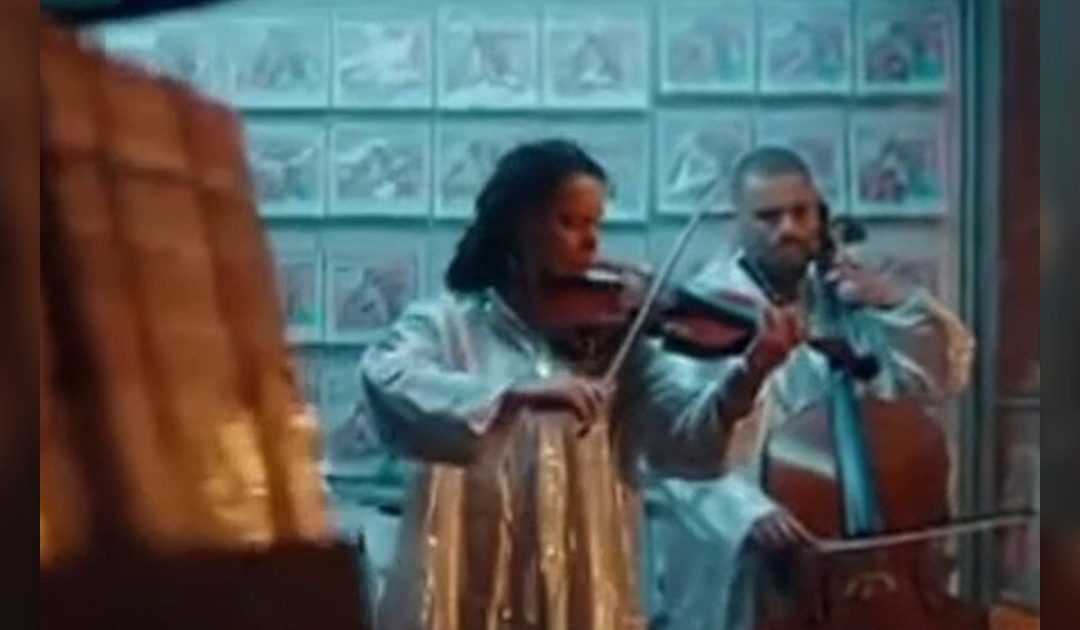
This Midnight Newsstand Orchestra Sora 2 Prompt makes a compact music video with a moving camera, wet-night color, and a readable sign. Use it when a short vertical or horizontal social clip needs one clear action instead of a pile of disconnected details.
Midnight newsstand performance
A single 4-second 16:9 cinematic shot inside a rain-slicked midnight newsstand. A violinist, a cellist, and a drummer in silver raincoats play a tight crescendo while the camera dollies from a rack of glossy magazines to their hands and faces. The blue neon sign above them reads LAST EDITION in crisp block letters. Steam rises from the street, passing taxis throw amber reflections across the floor, natural performance motion, shallow depth of field, 35mm film texture, no cuts.Settings: openai/sora-2, 16:9, 720p, 4 seconds, text-to-video.
Variations
Dawn flower cart quartet
A single 4-second 9:16 vertical shot of a dawn flower cart at a quiet city corner. A florist in a mustard coat hands out bright ranunculus to two cyclists as the camera makes a gentle handheld push through the buckets of flowers. Pink morning light, wet pavement, soft lens flare, documentary realism, one continuous shot, no cuts.Settings: openai/sora-2, 9:16, 720p, 4 seconds, text-to-video.
Why this Midnight Newsstand Orchestra Sora 2 Prompt works
- The first sentence locks the clip into one location, which gives the short duration a useful boundary.
- Three named instruments make the performance readable without asking for a crowd scene.
- The dolly path tells the camera where to start and where to finish.
- The sign gets its own clear instruction, including exact words and a simple block-letter treatment.
- Blue neon, amber taxi reflections, and steam establish contrast that can survive a four-second cut.
A short shot works best when the action has a beginning and an end. Here, the musicians build a crescendo while the camera moves closer. That gives the clip a small arc without requiring a scene change. The prompt also leaves room for performance details, such as bow movement and reflections, instead of micromanaging every frame.
Camera direction matters more than a long list of visual references. The instruction begins on magazines, then lands on hands and faces. This keeps the newsstand in the story while giving the music a human center. The close focus also helps the scene feel like a real street-side shoot rather than a wide establishing shot.
Readable lettering is a harder request, so the prompt makes it brief. LAST EDITION has two common words, a practical location above the performers, and a contrasty neon treatment. The result may vary between generations, but a short phrase gives the model a better target than an entire poster paragraph.
OpenAI’s Sora 2 prompting guide recommends treating a prompt like a storyboard: identify the framing, depth, lighting, and action. This example does that in the order a viewer experiences them. It is specific, but it doesn’t drown the motion in technical jargon.
More Sora 2 prompts
Browse the full Sora 2 Prompts collection. For more clips, try Moonlit Kite Repair Sora 2 Prompt, Chalkboard Pasta Lesson Sora 2 Prompt, and Kinetic Tea Table Sora 2 Prompt. For another moving-camera approach, see Veo 3.1 Prompts.
Run this prompt yourself
Every example above was generated on Wiro. Paste the prompt, pick the model, and get your own result.