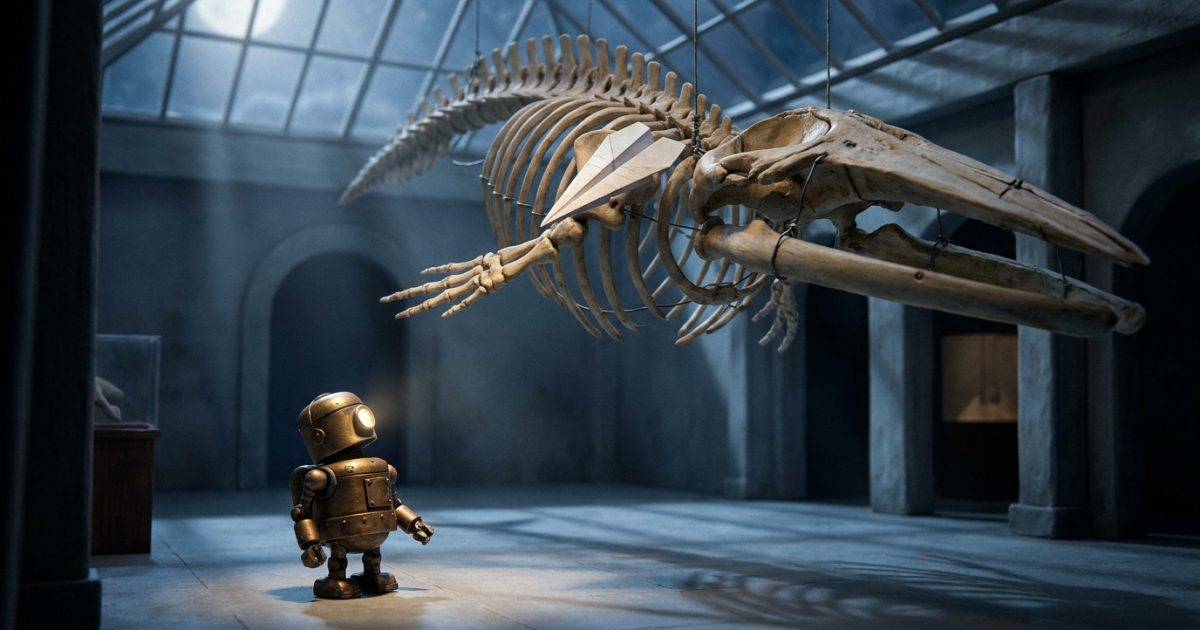
This Museum Heist Plan Seedance 2.5 prompt makes a tiny after-hours museum story with a clean camera move and tactile stop-motion detail. Use it when a five-second clip needs a beginning, a discovery, and a final reveal.
Museum Heist Plan Seedance 2.5 prompt
Main gallery chase
The action has one clear trigger: the paper airplane. That gives the robot a reason to move, while the tracking shot and high reveal supply a compact visual arc.
A tiny museum security robot rolls through a moonlit gallery after closing, pauses beneath a suspended whale skeleton, then spots a paper airplane gliding past a framed landscape. The camera tracks low beside it, rises over the robot as it follows the airplane through a doorway, and ends on a wide reveal of the empty glass-roofed atrium. Polished stop-motion miniature craft, brass details, soft pool lighting, shallow depth of field, 35mm lens. Audio: quiet wheel hum, distant rain on glass, one soft paper flutter.Settings: ByteDance Seedance 2.5, 16:9, 720p, 5 seconds, MP4, synced audio, prompt enhancement on, watermark off.
Variations
Clockwork skylight exit
This vertical version trades the chase for a single upward exit. It works well for reels because the final crane gives the frame a strong finish.
A clockwork bird made of brushed copper lands on a museum display plinth at dawn. It folds its wings, picks up a small paper museum map, and takes off through an open skylight as the camera cranes upward to follow. Stop-motion miniature craft, warm sunrise shafts, crisp mechanical detail, 50mm lens. Audio: gentle gears, wing clicks, airy room tone.Settings: ByteDance Seedance 2.5, 9:16, 720p, 5 seconds, MP4, synced audio, prompt enhancement on, watermark off.
Why this Museum Heist Plan Seedance 2.5 prompt works
- It gives the model a small, readable subject instead of a crowded cast.
- The paper airplane creates a visible cause for the robot’s movement.
- Camera instructions progress from low tracking to a wide reveal.
- Material notes such as brass and miniature craft keep the look consistent.
- Short sound cues support the empty-gallery mood without competing with the action.
The useful trick is sequence order. Start with the place, introduce the change, then state where the camera lands. Seedance 2.5 has enough room in five seconds for that rhythm when each beat stays simple. The robot also avoids the face consistency problems that can distract from a miniature story. For another take, keep the same action chain and replace only the object that catches its attention. A glowing key, rolling marble, or loose museum label can all create a new short without rebuilding the shot.
For cleaner results, avoid adding a second plot twist after the airplane appears. Five seconds is enough for one decision and one destination. The prompt also names the final composition rather than asking for a vague cinematic ending. That detail matters when the clip needs to cut neatly into a larger sequence. Keep the robot small in frame at first, then let the rising camera make the atrium feel enormous. The contrast sells the miniature scale.
More Seedance 2.5 prompts
Browse the full Seedance 2.5 Prompts collection for more clips. For related ideas, try Rooftop String Quartet, Paper City Rain, and Library Bookstorm. Camera-led scenes also work well in the Kling 3.0 Prompts category.
The model maker’s documentation: Seedance on ByteDance Seed.
Run this prompt yourself
Every example above was generated on Wiro. Paste the prompt, pick the model, and get your own result.