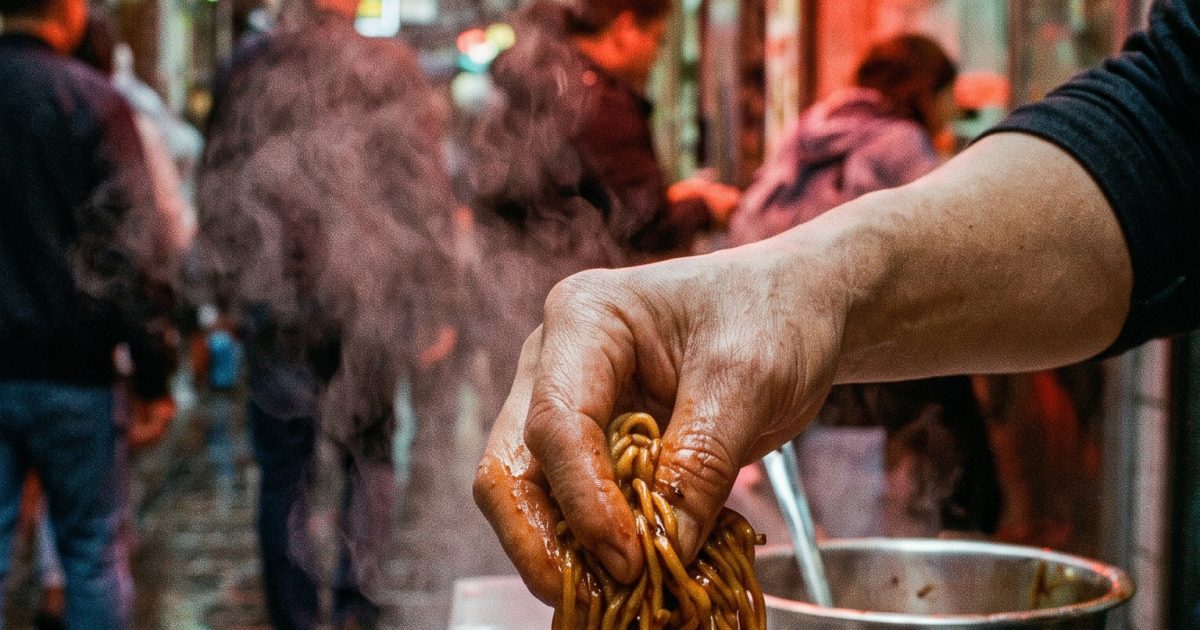
Night market Kling 3.0 prompt turns a simple food scene into a short vertical film with one clear action, a moving camera, and a place that feels lived in. Use it for food reels, menu teasers, or mood boards that need more than a still bowl on a table.
Night Market Noodles
A single continuous 5-second vertical night-market food film. Start in a tight macro on a cook with believable hands folding steaming chili oil noodles into a blue ceramic bowl. The camera pulls back and rises through a crowded Taipei alley as the bowl is passed to a smiling customer. Rain reflects neon on the pavement. A red stall sign behind them reads LATE NOODLES in crisp readable letters. Natural wok sizzle, street chatter, cinematic 35mm texture, warm red and teal light.Settings: Kling 3.0 (klingai/kling-v3), text-to-video, 9:16, standard 720p, 5 seconds, sound on.
Variations
Night Skewers
A 5-second vertical documentary food shot in a rainy Seoul alley. The camera tracks beside a vendor with believable hands placing grilled skewers into a paper tray, then rack-focuses to a customer lifting one toward the lens. Steam, orange stall lamps, wet asphalt reflections, shallow depth of field, soft film grain. A small menu board says NIGHT SKEWERS in clear white lettering. Realistic sizzling and distant conversation.Settings: Kling 3.0 (klingai/kling-v3), text-to-video, 9:16, standard 720p, 5 seconds, sound on.
Why this Night Market Kling 3.0 prompt works
- The cook, bowl, alley, and customer arrive in that order. Kling gets a stable subject before the camera opens the scene.
- The macro-to-rising move gives the clip one readable direction instead of competing camera instructions.
- Hands have a job: fold noodles, then pass the bowl. Specific actions tend to look more believable than generic motion.
- Rain, neon, and steam each affect a different part of the image. That leaves room for texture without turning the prompt into a prop list.
- The sign text is short and placed in the background, which gives Kling a practical target without making text the whole shot.
Keep the sequence compact. A five-second food clip works best when the viewer understands the action before the final second. Swap the dish, city, or color pair, but keep one camera move and one hand-off. For a quieter result, remove the crowd and use only the wok sound. For more energy, ask the camera to track faster rather than adding a second scene.
Camera language matters here. Tight macro describes the opening frame, while pull back and rise describes the transition. The line about the customer tells the model where the clip should finish. That sequence gives the film a tiny story: preparation, reveal, and reaction. It also gives editors a natural place to cut into a longer reel.
Food texture does not need a long list. Steam, chili oil, wet pavement, and a ceramic bowl each deliver a different cue. The warm red and teal lighting keeps the scene legible on a phone screen. If a render feels cluttered, remove one atmosphere detail before changing the subject. If it feels flat, strengthen the practical light or choose one stronger foreground action. Keep requested words brief. The LATE NOODLES sign sits behind the action, so it supports the scene rather than becoming a graphic-design task.
More Kling 3.0 prompts
Browse the full Kling 3.0 prompt collection for short-form video ideas. For another product-led video approach, see Veo 3.1 prompts.
More on the model itself: Kling AI's official site.
Run this prompt yourself
Every example above was generated on Wiro. Paste the prompt, pick the model, and get your own result.





2 Comments