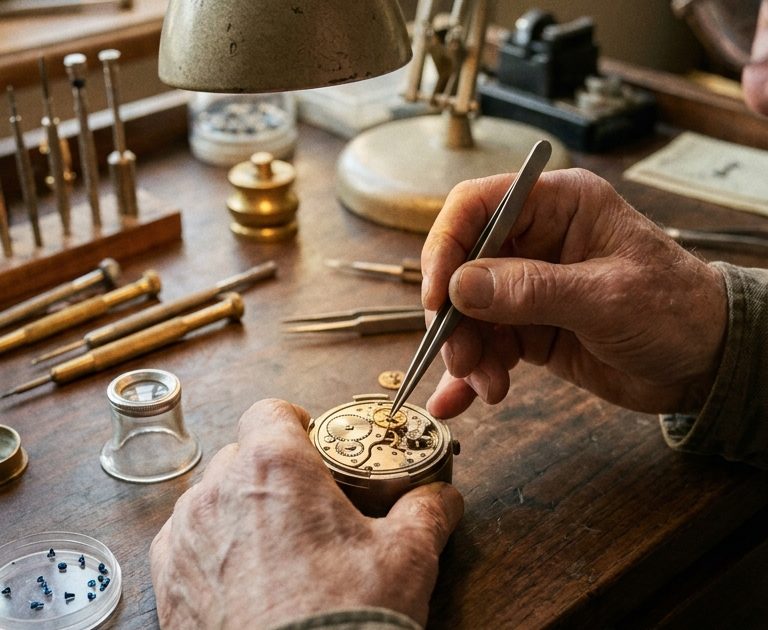
This Mechanical Watchmaker Kling 3.0 Prompt makes a tactile craft-film clip where careful hands, tiny parts, and a controlled camera move carry the story. Use it for product concepts, maker reels, or close-up scenes that need believable detail instead of a generic luxury montage.
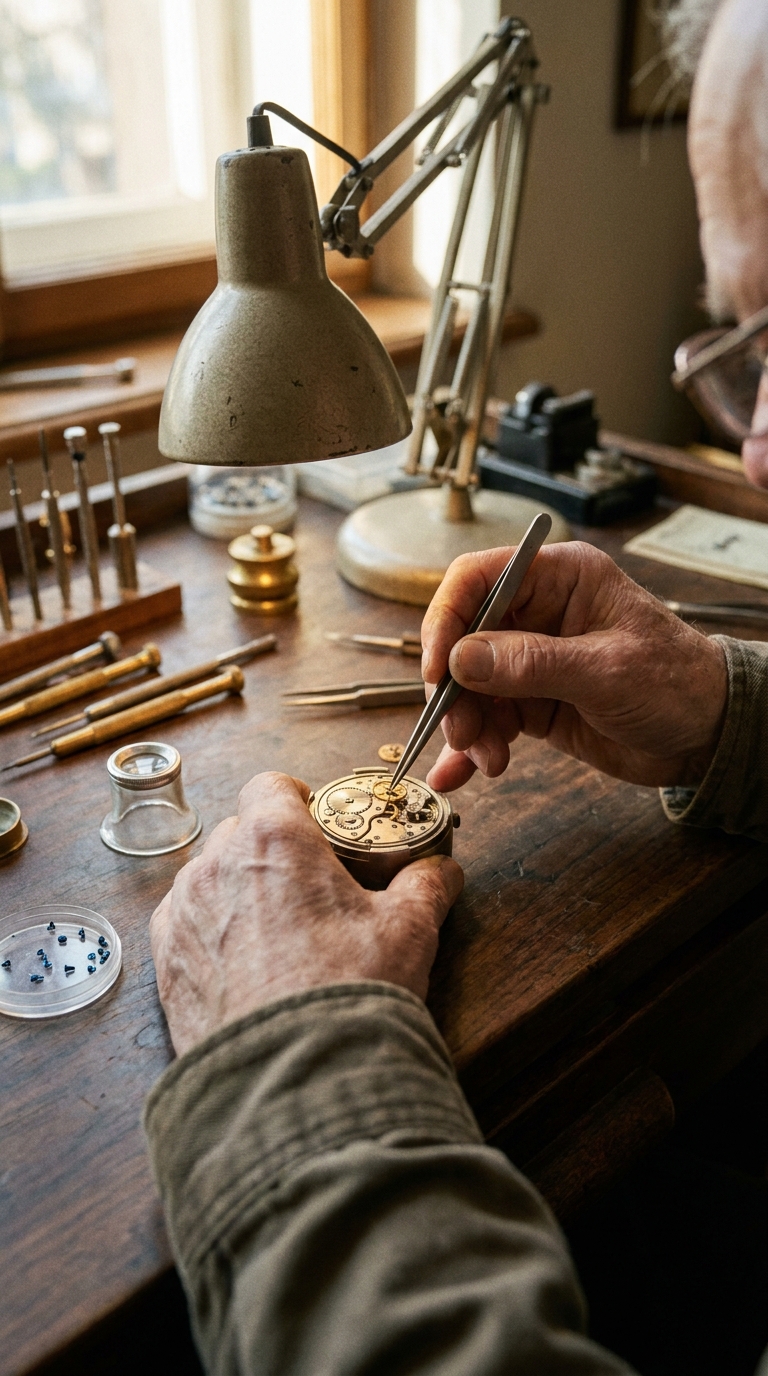
Main watch repair
At a walnut workbench, an independent watchmaker uses tweezers to lower a tiny brass gear into an open mechanical wristwatch. Start in extreme macro on the gear, rack focus to both careful hands, then make a slow half-orbit around the watch as the balance wheel begins to tick. Warm window light meets a practical desk lamp, shallow depth of field, 85mm macro lens, tactile editorial realism, no logos.Settings: Kling 3.0 (klingai/kling-v3), text-to-video, 9:16, standard 720p, 5 seconds, sound off.
Variations
Bench-side reveal
An independent watchmaker repairs an open mechanical wristwatch at a walnut bench. Begin over the shoulder, then push in as both hands turn the crown and the tiny brass gears begin moving. The camera slides sideways past the loupe and blue screws, ending on the finished watch catching warm light. Controlled dolly move, 50mm macro photography, crisp metal texture, shallow depth of field, no logos.Settings: Kling 3.0 (klingai/kling-v3), text-to-video, 9:16, standard 720p, 5 seconds, sound off.
Why this Mechanical Watchmaker Kling 3.0 Prompt works
- The shot starts with one small object, then gives the camera a precise focus change.
- Tweezers, a brass gear, and blue screws tell the model what scale and materials to render.
- Both hands have a single job, which keeps the movement readable.
- The half-orbit adds parallax without forcing a jump between angles.
- Warm window light and a desk lamp create a useful mix of soft and hard reflections.
This Mechanical Watchmaker Kling 3.0 Prompt works because every detail belongs to the same small workspace. The gear goes into the watch. The hands place it. The balance wheel starts. The camera moves only after the action is established. That sequence gives a five-second clip a beginning, middle, and finish without needing a second scene.
Macro prompts benefit from material words. Brass suggests warm reflections, walnut gives the bench texture, and blue screws create a small color accent. Those details make the frame easier to read on a phone screen. The 85mm macro direction keeps the result intimate. If the shot feels too busy, remove one prop before adding more description.
For a different product category, keep the camera grammar and swap the object. A fountain pen nib, a miniature camera, or a jewelry clasp can use the same rack focus and half-orbit. Avoid logos, serial numbers, and long text. Small moving mechanisms make a better ending than a hard cut to a product packshot.
More Kling 3.0 prompts
Browse the full Kling 3.0 Prompts collection for clips and settings.
- Sneaker Orbit Kling 3.0 Prompt
- Glass Pastry Lab Kling 3.0 Prompt
- Night Market Kling 3.0 Prompt
- For still product studies, browse GPT Image 2 Prompts.
For the maker’s own notes on this model, see Kling AI's official site.
Run this prompt yourself
Every example above was generated on Wiro. Paste the prompt, pick the model, and get your own result.