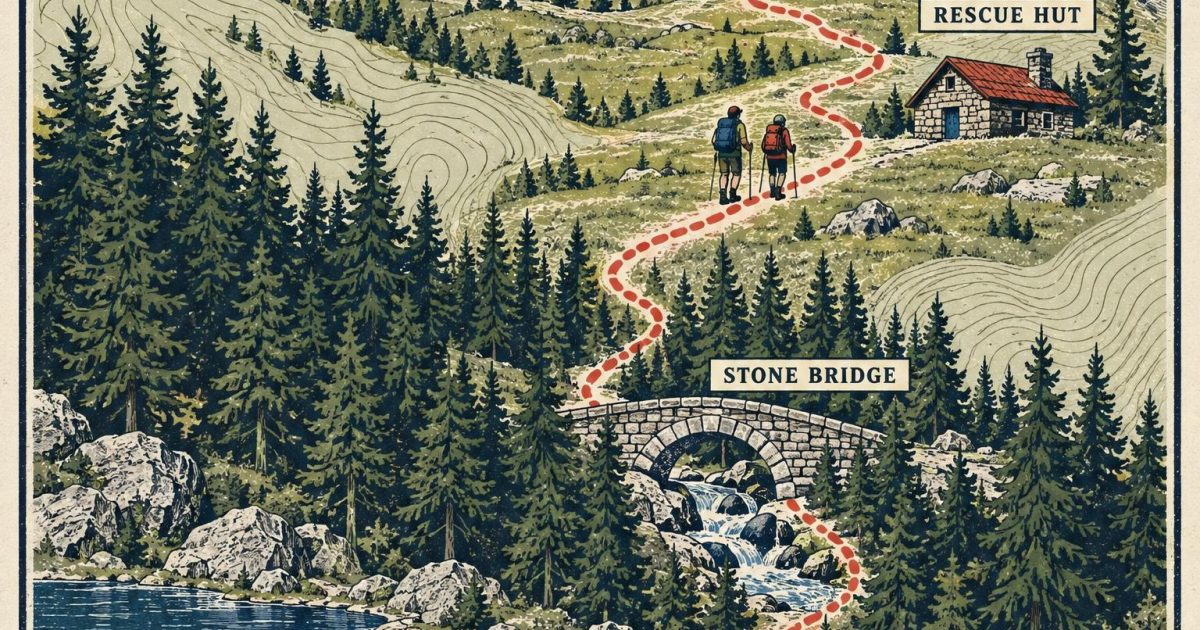
Trail Map Poster GPT Image 2.5 Prompt turns a detailed route brief into a printed field guide with readable labels, a deliberate palette, and a clear visual path. This test uses GPT Image 2.5 Sunburst at 2k, where the extra quality setting helps when the image needs both illustration and small type.
Table of contents
Trail Map Poster GPT Image 2.5 Prompt
The main prompt asks for a route that can be followed with the eye: lake, bridge, meadow, hut, then ridge. It also gives the lettering a job. Each label belongs to a specific landmark, rather than floating as decorative text. That makes this a useful starting point for a fictional trail, event route, or destination poster.
Mistral Pass field guide
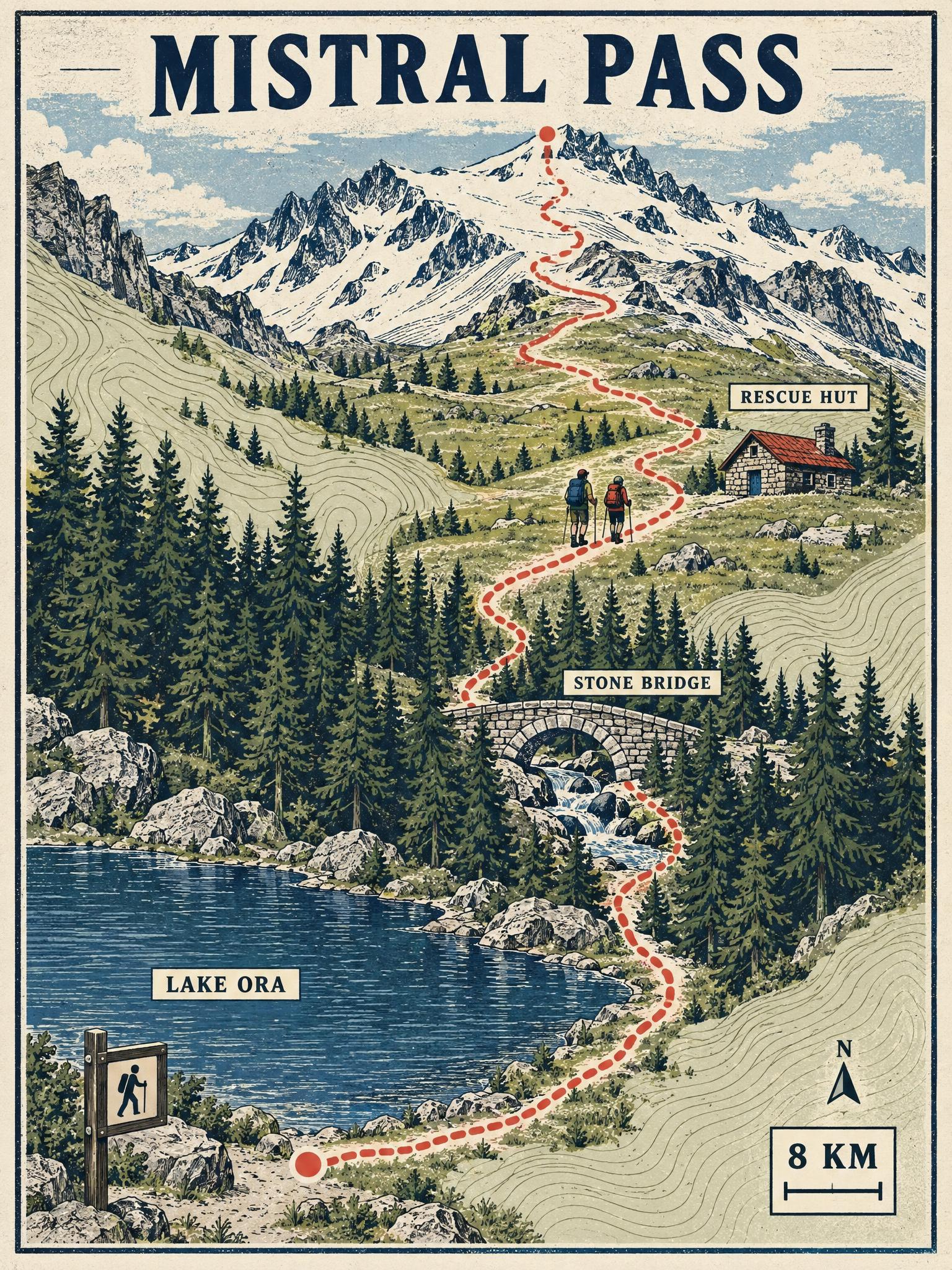
Create a vertical illustrated trail map poster for a fictional alpine route called MISTRAL PASS. Show a winding red trail from a lakeside trailhead through pine forest, a stone bridge, a meadow with two hikers and a rescue hut, finishing at a snow ridge. Add clear, correctly spelled labels: MISTRAL PASS at the top, LAKE ORA, STONE BRIDGE, RESCUE HUT, and 8 KM. Screen-printed field-guide style, limited ink palette of deep navy, cream, rust red, and moss green, fine contour lines, paper grain, balanced margins, crisp legible typography, no logos.Settings: openai/gpt-image-2-5-sunburst, 3:4 ratio, 2k resolution, high quality, JPEG, opaque background, 1 sample.
Use named landmarks when the map must feel believable. The route reads more clearly when the landmarks change scale and texture along the way: water, trees, stone, grass, then snow. The requested ink colors also stop the poster from becoming a generic digital landscape.
Variations
Aurora Cove route
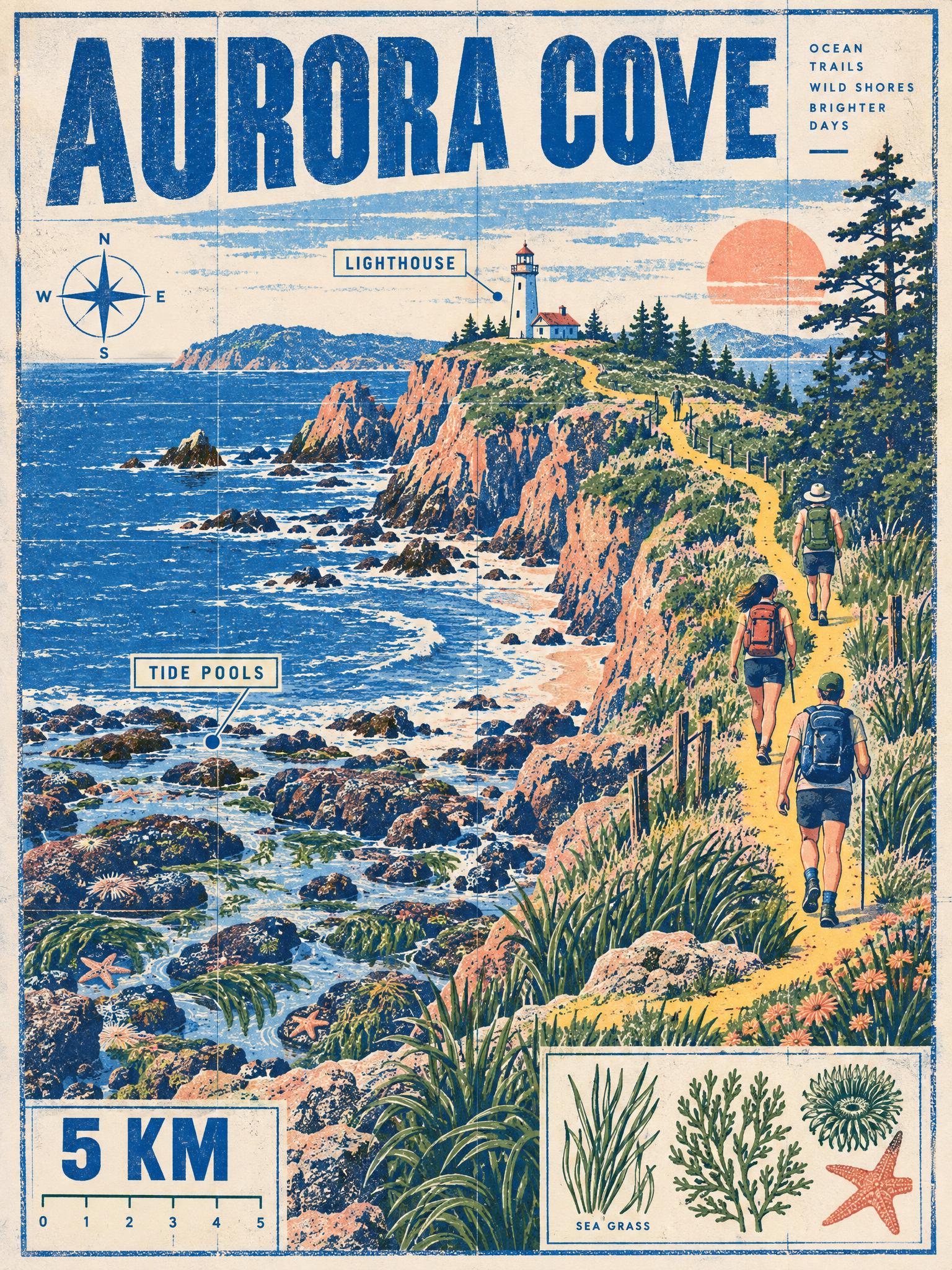
Create a vertical illustrated map poster for a coastal walking route called AURORA COVE. Show a blue shoreline, a small lighthouse, tide pools, sea grass, and a yellow path with three hikers. Add clear labels: AURORA COVE, TIDE POOLS, LIGHTHOUSE, and 5 KM. Risograph travel-poster style, cobalt blue, faded coral, warm cream and seaweed green, precise linework, slightly misregistered ink texture, strong grid, sharp readable type, no logos.Settings: openai/gpt-image-2-5-sunburst, 3:4 ratio, 2k resolution, high quality, JPEG, opaque background, 1 sample.
Moonlit Ridge route
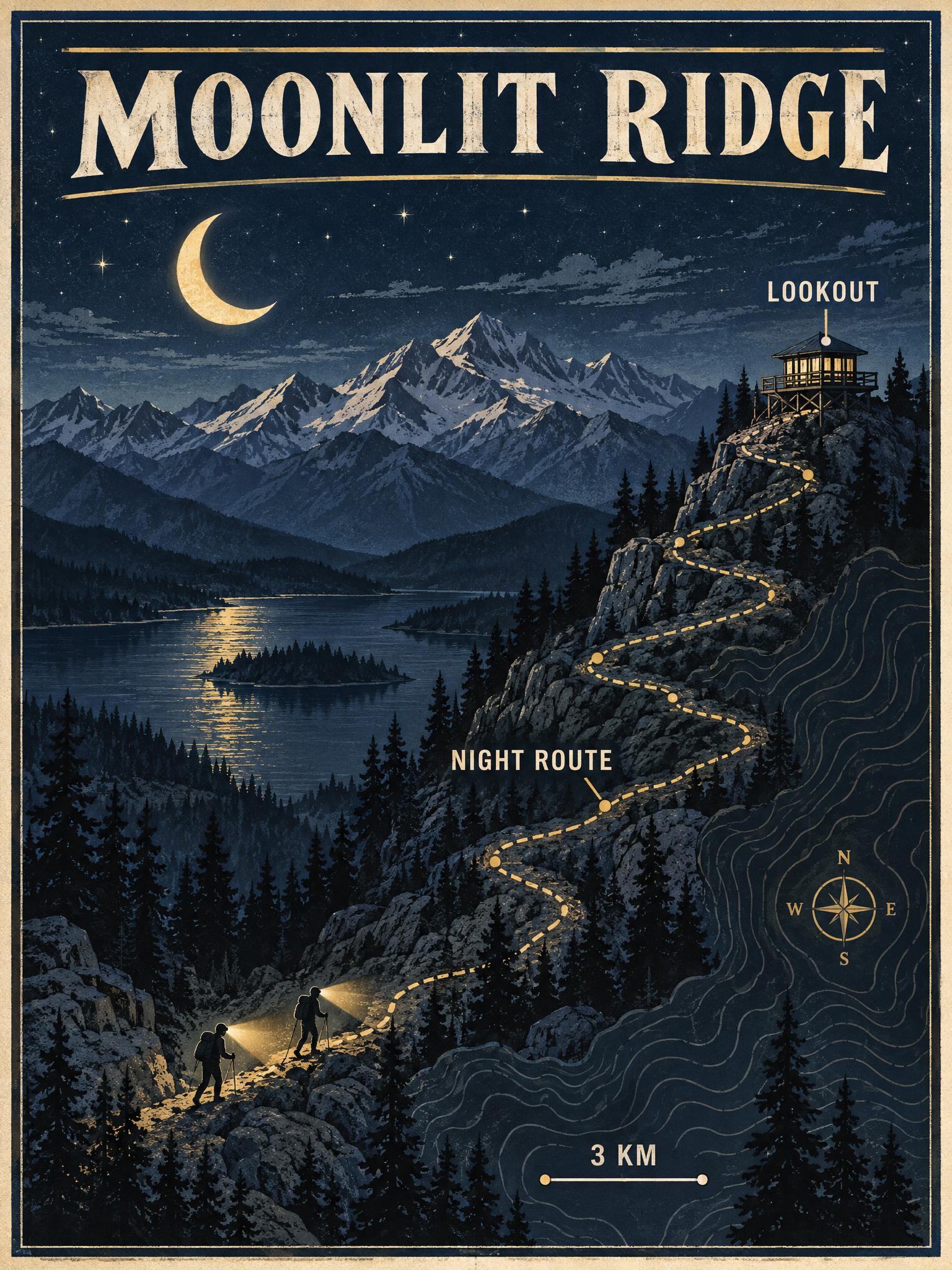
Create a vertical illustrated night trail map titled MOONLIT RIDGE. Show a crescent moon over mountains, switchback trail, two tiny hikers with headlamps, a lookout platform, and a dark lake. Add correct labels: MOONLIT RIDGE, LOOKOUT, NIGHT ROUTE, and 3 KM. Vintage national-park print, midnight blue, silver gray, faded gold and cream, topographic contours, clean spacing, crisp legible typography, no logos.Settings: openai/gpt-image-2-5-sunburst, 3:4 ratio, 2k resolution, high quality, JPEG, opaque background, 1 sample.
Why this Trail Map Poster GPT Image 2.5 Prompt works
- It starts with the deliverable, so the model knows this is a poster rather than a scenic illustration.
- It gives the route an ordered sequence of landmarks, which shapes composition without asking for a crowded map.
- It isolates exact text and assigns it to the poster, a useful approach for testing typography.
- It limits the palette before asking for texture, keeping the print treatment coherent.
- It calls for margins and a grid, which protects the hierarchy around the title and route.
OpenAI recommends describing the subject, composition, style, and constraints separately. Its image prompting guide also recommends stating which details must remain precise. Here, route order and labels are the constraints that matter most.
More GPT Image 2.5 prompts
Browse all GPT Image 2.5 Prompts, or try the related Solstice Line GPT Image 2.5 Prompt and Blue Hour Perfume GPT Image 2.5 Prompt. For a different image model collection, see GPT Image 2 Prompts.
Run this prompt yourself
Every example above was generated on Wiro. Paste the prompt, pick the model, and get your own result.



1 Comment